All of southern Minnesota and northern Iowa is in EPA Radon Zone 1 — the highest-risk classification. Every home should be tested before purchase. Mitigation when needed costs $1,500-$3,000. Testing during inspection costs $150 and is the only way to know.
What is radon?
Radon is a naturally-occurring radioactive gas produced by the breakdown of uranium in soil and rock. It is colorless, odorless, and tasteless. It seeps from the ground into homes through foundation cracks, sump pump openings, and other entry points — and accumulates in the lowest occupied levels.
Radon is the second-leading cause of lung cancer in the United States, responsible for an estimated 21,000 deaths annually. The EPA recommends action when indoor levels exceed 4.0 picocuries per liter (pCi/L).
Why is our entire service area Zone 1?
EPA Radon Zone 1 covers areas where the predicted average indoor radon level is above 4.0 pCi/L. Every county in our service area is Zone 1:
- Minnesota: Martin, Faribault, Blue Earth, Nicollet, Brown, Watonwan, Cottonwood, Jackson, Nobles, Murray, Lyon, Waseca, Freeborn — all Zone 1
- Northern Iowa: Emmet, Dickinson, Palo Alto, Clay, Kossuth — all Zone 1
The geological reason: this region sits on glacial till and limestone bedrock with naturally elevated uranium content. Radon production from this geology is among the highest in the United States.
How testing works
There are two main testing approaches: short-term (48 hours, used during real estate transactions) and long-term (90+ days, used for thorough year-round assessment). For home purchase, we use short-term continuous-monitor testing per EPA protocol.
- 1. Deployment. At the inspection, we place a calibrated continuous radon monitor in the lowest livable area of the home (typically a basement bedroom or living area).
- 2. 48-hour wait. Closed-house conditions are required: doors and windows closed except for normal entry/exit. Heating/cooling normal operation.
- 3. Pickup and reading. Monitor is collected. Hour-by-hour readings are downloaded.
- 4. Report. Detailed report within 24 hours, showing every hourly reading, the average, and our recommendation.
What to do if levels are elevated
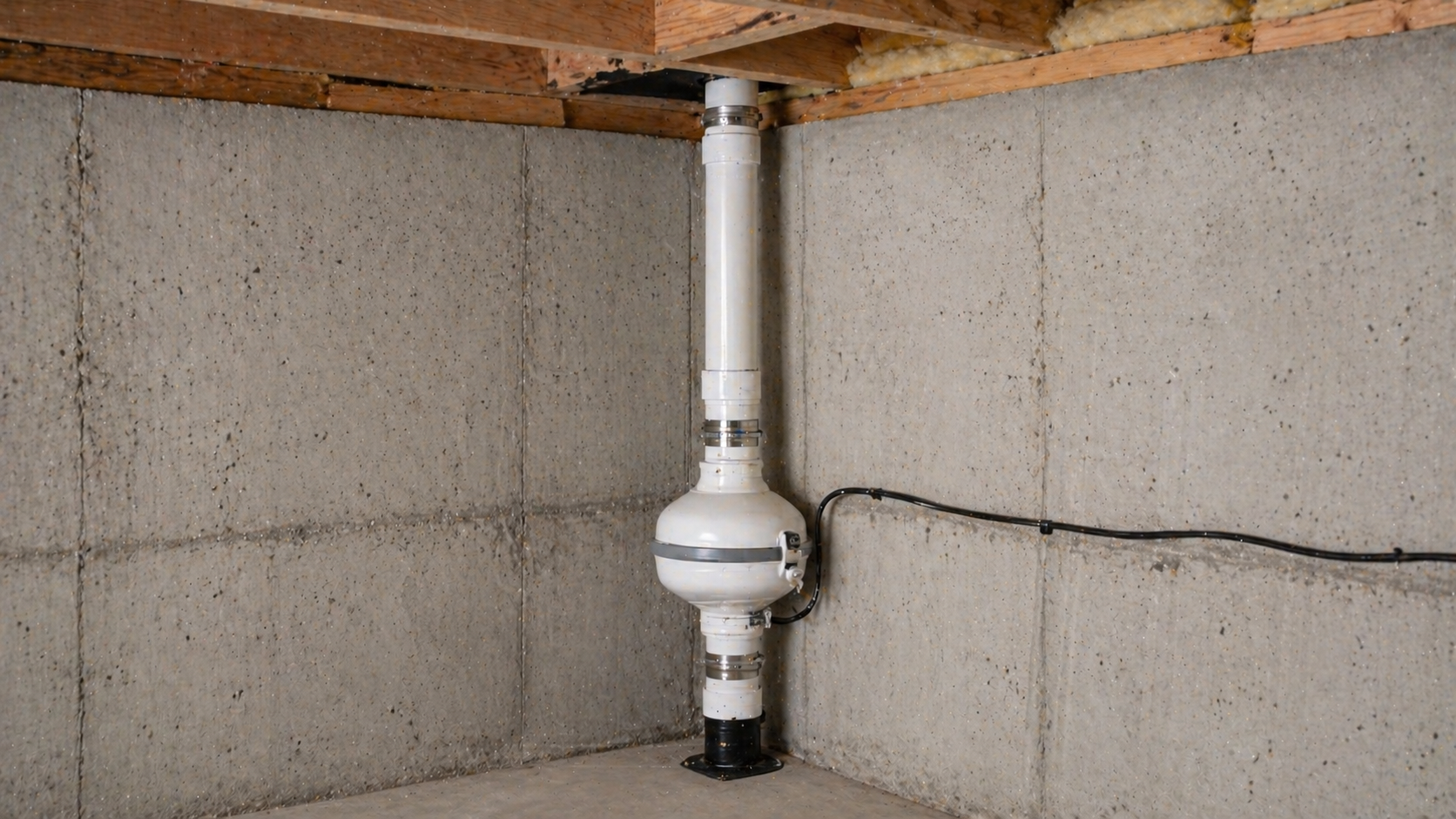
Mitigation systems are highly effective — typically reducing radon by 90%+ to well below action threshold. The standard approach is sub-slab depressurization: a fan continuously draws air from beneath the foundation slab and vents it above the roofline, preventing radon from entering the home.
- Cost: $1,500-$3,000 installed in southern MN and northern IA
- Time: Installation typically takes a single day
- Operating cost: Negligible — the fan uses about as much electricity as a low-watt light bulb
- Lifespan: 20+ years for the system; fans typically need replacement every 8-12 years
In a real estate transaction, sellers commonly cover mitigation costs as part of inspection-contingency negotiation.
Iowa vs. Minnesota — minor protocol differences
Iowa and Minnesota have nearly identical radon programs but slightly different licensing requirements for testers and mitigators. Our testing protocols are recognized in both states.
Common questions about radon testing
Why is southern Minnesota in EPA Radon Zone 1?
EPA Zone 1 is the highest-risk zone, with predicted average indoor radon levels above 4 pCi/L. All counties in our service area — Martin, Faribault, Blue Earth, Nicollet, Brown, Watonwan, Cottonwood, Jackson, Nobles, Murray, Lyon, Waseca, Freeborn — are Zone 1. Northern Iowa counties are similarly classified.
Do I really need to test for radon if I am buying a home?
Yes. EPA recommends testing every home in Zone 1, every time. Radon levels vary house-to-house even on the same street. The only way to know is to test.
How much does radon mitigation cost?
Mitigation systems cost $1,500-$3,000 installed in southern Minnesota and northern Iowa. Sellers commonly cover this in negotiation when testing reveals elevated levels.
How long does the radon test take?
48 hours minimum, per EPA short-term test protocol. We deploy a continuous radon monitor at the inspection and pick it up 48 hours later. Results within 24 hours of pickup.
Can I do my own radon test?
You can buy a charcoal-canister kit at home stores. These work but give a single average reading and can be tampered with. Real estate transactions almost always require professional continuous-monitor testing for credibility.
What if the radon level is borderline?
EPA action level is 4.0 pCi/L. Levels of 2.0-4.0 are below action threshold but still indicate elevated risk — many buyers and sellers negotiate mitigation in this range as well.
Add radon testing to your inspection
$150 add-on. Get an instant quote in 60 seconds.
Radon Testing Details →