A standard home inspection cannot evaluate the main sewer lateral — only a camera scope can. On any home over 20 years old in southern Minnesota and northern Iowa, a $200 sewer scope is essential due-diligence. Sewer lateral failures cost $5,000-$15,000+ to repair.
What a standard inspection does NOT cover
Your standard residential home inspection covers visible plumbing inside the home — supply lines, fixtures, drain stacks, water heater. What it cannot cover: everything from the cleanout to the city main. That's the main sewer lateral — typically a 4" or 6" pipe running 30-100+ feet underground.
Lateral failures are some of the most expensive surprise repairs in home ownership. And the only way to evaluate the lateral is with a camera.
What sewer scope reveals
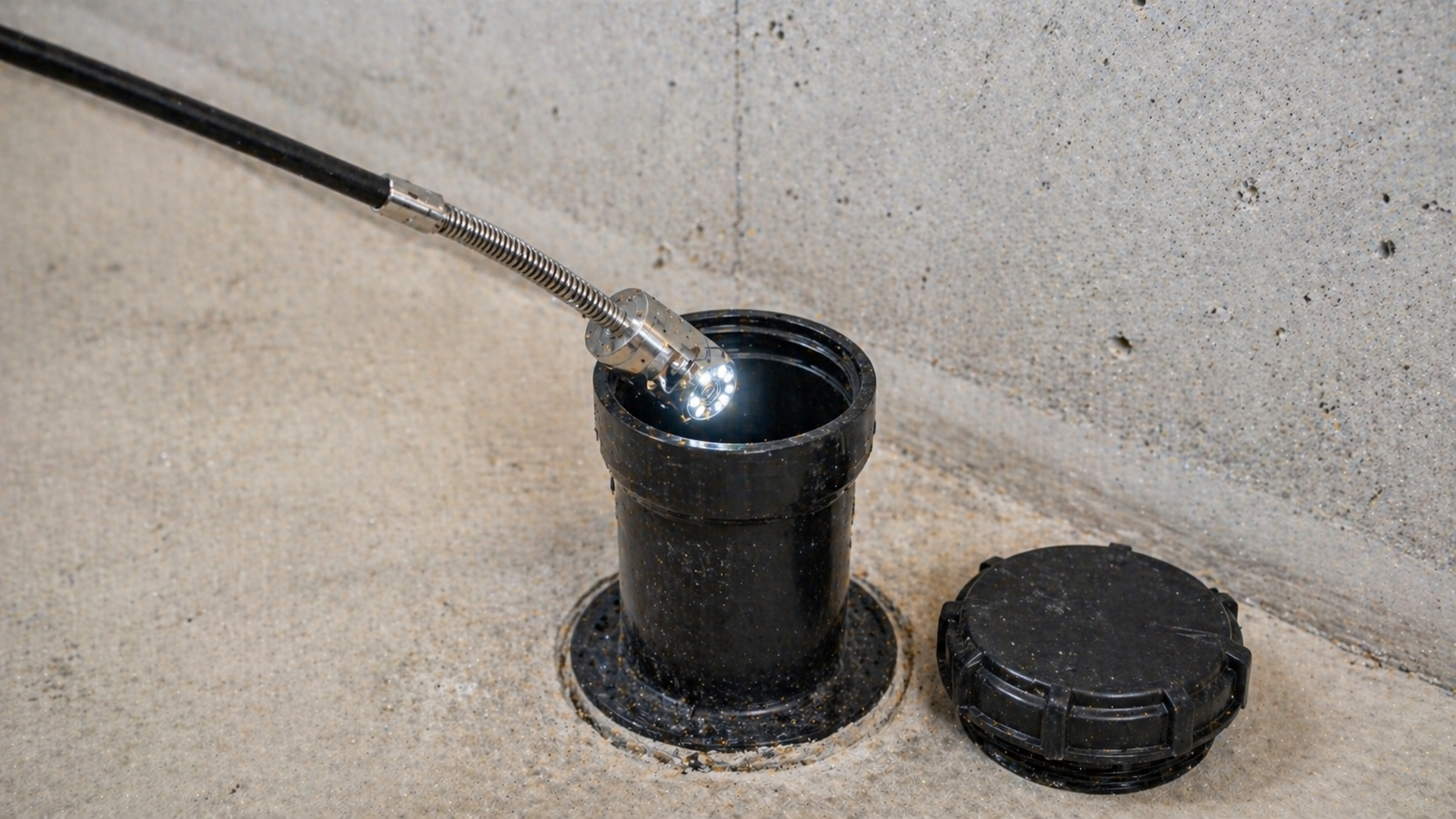
We feed a high-resolution camera through the cleanout (or, if no cleanout exists, pull a toilet) and run it the entire length of the lateral, documenting:
- Pipe material: Cast iron, clay, PVC, ABS, Orangeburg (a 1950s tar-paper pipe known to fail catastrophically)
- Cracks and breaks: Hairline to full circumferential
- Tree root intrusion: The most common finding in older neighborhoods
- Bellies (low spots): Where waste pools and accumulates
- Offsets: Joint separation where pipes have shifted
- Collapses: Sections fully or partially collapsed
- Connection to main: Type and condition
- Foreign object blockages: Common cause of repeated backups
Material types and their issues
Cast iron (pre-1980)
Cast iron sewer laterals were standard pre-1980. Typical service life 50-75 years — meaning many southern Minnesota homes are now at end-of-life. Failure mode: corrosion from inside out, eventually cracking and collapsing.
Clay (pre-1970)
Clay pipe was used in many small-town and rural lateral installations. Typical service life 50-100 years. Failure mode: tree root intrusion through joints and cracks. Almost universal in pre-1950 homes throughout our service area.
Orangeburg (1945-1972)
A tar-paper composite pipe used during post-WWII material shortages. Manufacturer-rated service life 50 years; reality is more like 30-50. Failure mode: deformation and collapse. Always recommend replacement when found.
PVC (1980+)
Modern standard. Typical service life 100+ years if properly installed. Failure modes are usually installation-related (joint separation, settling).
The math: why $200 prevents $15,000 surprises
Sewer lateral replacement in southern Minnesota typically costs:
- Yard-only excavation: $5,000-$8,000
- With street excavation: $10,000-$20,000
- With curb cut and pavement repair: $20,000-$30,000+
- Trenchless / pipe-bursting (when accessible): $7,000-$15,000
A $200 scope tells you in 30 minutes if you're walking into one of these surprises. If we find a problem, you have video evidence to negotiate seller credit, request seller repair, or walk away — all options that disappear after closing.
When you really should NOT skip it
- Any home built before 1980
- Any home with mature trees within 20 feet of the lateral path
- Any home with prior sewer backup history
- Any home where you don't see a cleanout (suggests very old plumbing)
- Any home with original plumbing throughout
Common questions
What does a sewer scope show that a standard inspection does not?
A standard inspection is visual only and stops at the cleanout. A sewer scope feeds a camera through the entire main lateral, documenting cracks, root intrusion, bellies, offsets, collapses, and material identification — none of which are visible from above.
How old does a home have to be before a sewer scope makes sense?
Strongly recommended on any home 20+ years old. Required-knowledge on any home with cast-iron, clay, or Orangeburg sewer laterals (typically pre-1980).
How much does a sewer line replacement cost?
In southern Minnesota and northern Iowa, sewer lateral replacement typically runs $5,000-$15,000, with full street excavation projects reaching $20,000-$30,000. The $200 sewer scope is cheap insurance against this cost.
Will the seller pay for sewer line repairs found by my scope?
Often yes, when documented with video. Sewer line failures are major defects that most sellers will negotiate as part of the inspection contingency.
Does a sewer scope find tree-root issues?
Yes — root intrusion is one of the most common findings, especially in older Fairmont, Blue Earth, Worthington, and Mankato neighborhoods with mature trees.
Add sewer scope to your inspection
$200 add-on. 30 minutes. Could prevent a $15,000 surprise.
Sewer Scope Details →